

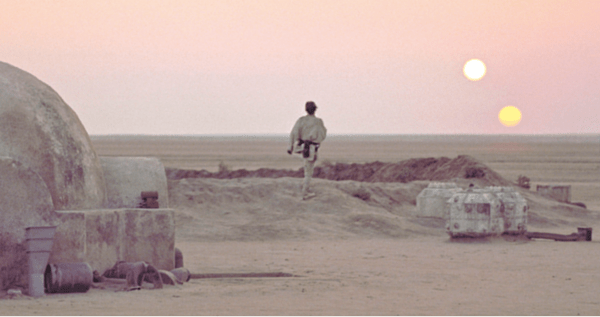
“This is my desert ‘camel!’ She flies through the sand to Tatooine!” Our driver was having a great time, tearing off-road through desert scrub and hurtling over sand dunes – some of which seemed a bit too big for this jeep that’s best days were clearly behind it. But he was having a good time, and we had seat belts, so that prevented our heads from hammering against the roof is the car.
The driver roared up sandy dunes and then sped down embankments. At times, he would pause at the apex for effect and add a noise – like the tik-tik-tik of a roller coaster – before hurtling us down towards the sands below. This man was an entertainer at heart. And, from the array of tire tracks on these dunes, it was clear that this was part of the experience he created for off-the-beaten-path travelers trying to get to the fictional Star Wars town of Mos Espa, hidden deep in the Sahara Desert. Our driver seemed to be doing his best Han Solo impression, and it felt like at any minute he would tell us to prepare for light speed. Whether this beaten up jeep could handle it was another question. But the Millennium Falcon itself has long been considered a hunk of junk, and, well, we all know how that story goes.
This was the final leg of a two-day journey into the Tunisian desert and to one of the best preserved Star Wars filming locations. This is said to be a pilgrimage site for Star Wars fanatics, and while I don’t count myself as part of their tribe, I’m always up for a little adventure and was curious if Tatooine – the desert planet of Star Wars lore and an actual city in Tunisia- really had two suns. And if not two suns, maybe just a lost Jedi or so.
Cruising southward toward the Tunisian Sahara, you’re more likely to run out of water before your car goes dry on gas. With a lack of official gas stations along these roads, enterprising Tunisians have set up roadside gas shops for passersby. Like real gas stations, these gas shops are remarkably consistent in style: near the road stands a tripod, its top affixed with a chute down which the gas will slide. The space around and behind the hand-crafted gas chute is filled with canisters of smuggled Libyan gasoline (the Libyan border is not far from this part of Tunisia). And, like in New Jersey, you can’t self-serve at this gas shop. Nope, that’s where the helpful attendant comes in – just don’t ask him the octane of what he’s dumping into your vehicle or to use the restroom while he works.


The road continues through what feels like an endless sea of olive trees stretching in all directions. Olive oil was the single most important export of the Tunisian economy for much of the last 100 years, and today, in a country of 12 million people, there are estimated to be more than 80 million olive trees. And most of those olives are still picked by hand! I wouldn’t be surprised is some of that second-press olive juice found it’s way into the aforementioned Libyan roadside fuel blend.
Eventually, the olive groves give way to rolling desert scrub and, on occasion, an oasis. They are hard to miss: massive date palms quickly burst onto the scene, crowded around a cluster of homes and small gardens, and then, just as quickly, give way to desert scrub once again. I scour the date palm clusters looking for camels crowded around small ponds of water like they always did in the cartoons. Time and again, I’m disappointed: no camels, no Jedi, and still only one sun. Would I have to ask for our money back?
Clearly, I’m not the only person who was expecting to find camels in these Saharan oases: our vehicle pulled up to what I can only be described as a South Tunisia Camel Carnival (STCC). Yes, there on the outskirts of the Saharan oasis town of Douz were more than 100 men and their dromedary (single hump) camels – and all of them were offering rides.

This was an operation. Prospective camel riders first entered a ticketing building to purchase a ride or Sahara-charge one’s ticket to include not just a camel ride through the dunes… but a 4-wheeler as well! At first, we planned to pass on the camel rides, but the Quad cycle upgrade convinced us to get back in the game (Jess with more than a bit of concern for the camels). Like any good amusement park experience, there were photos of you enjoying yourself for sale; cherished memories to take home from your trip to the South Tunisia Camel Caravan. So, for the next hour and a half, Jess and I wandered the northernmost stretch of the Sahara on camel back and tore through some dunes while doubling up on a quad cycle.

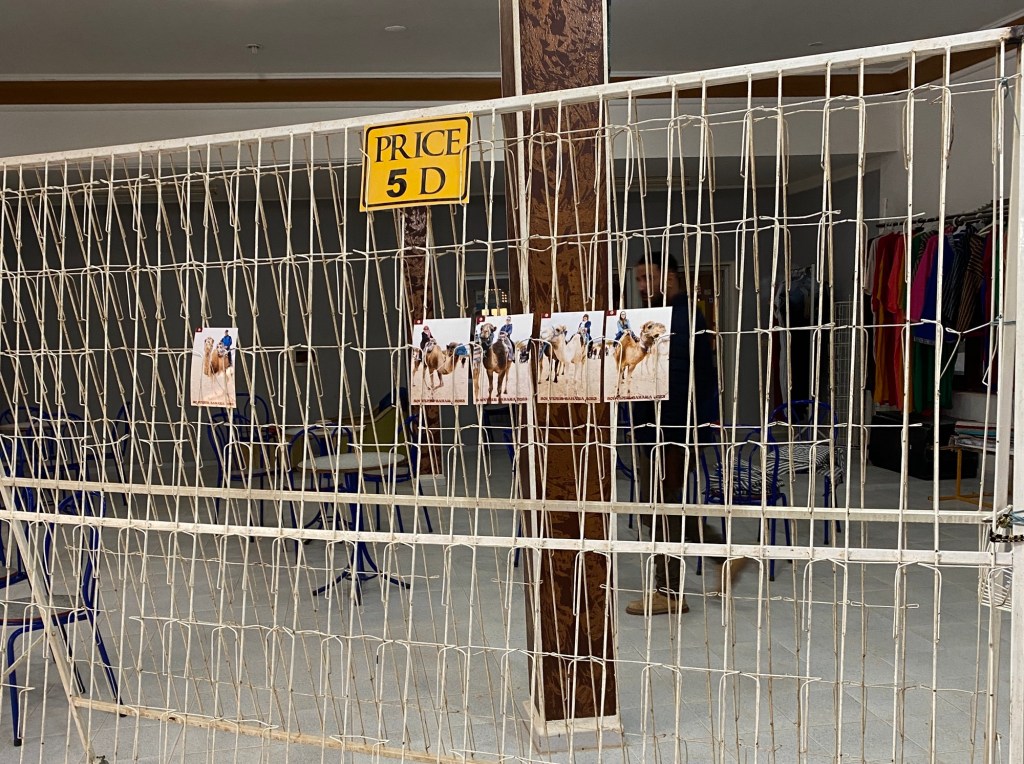
At sunset, we and the remaining dune adventurers retuned our quads to the parking area. We were just about back to our vehicle where it struck me: the STCC memorable photos! We had to check the photos! We didn’t have to go all the way back to the ticket booth to see the experience memorialized – the photographer carried the rack to the parking area “just for us.” The quality was low (“is that me, or the camel?” I wondered aloud as I reviewed my commemorative photo), but the price was right: $1.50. Sold! To the generally suspicious but quite gullible man now smelling like camel.
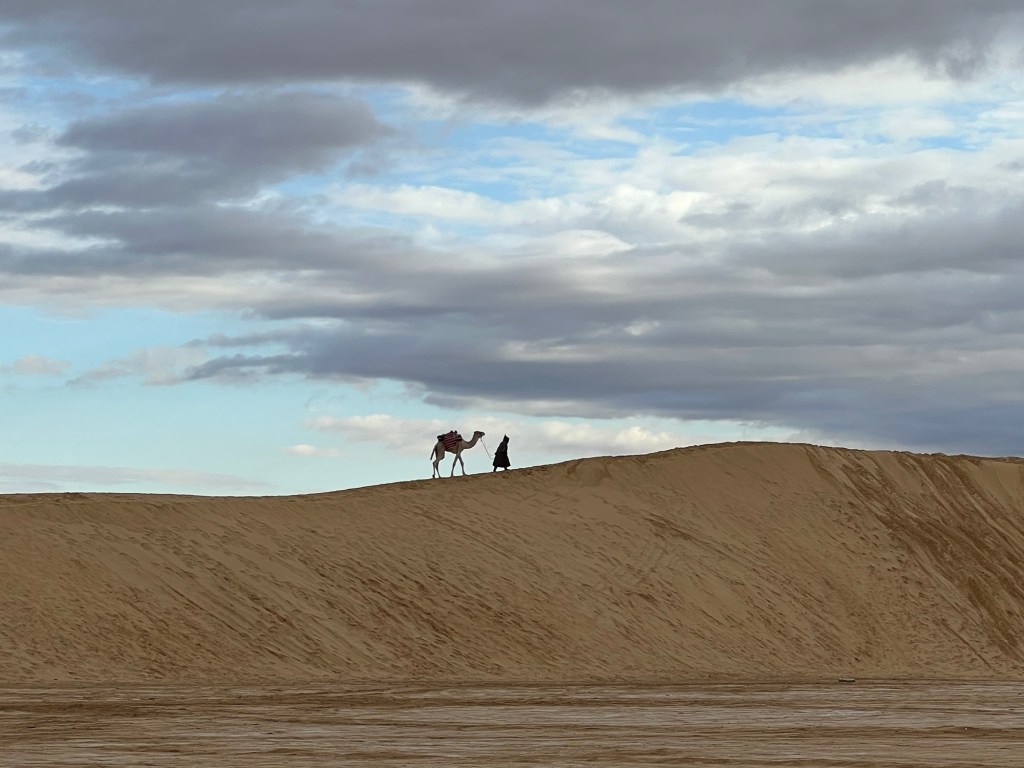
Sun (and only one, dammit!) had set on the first day of the trip to Mos Espa. While we had seen olive trees and date palms and experienced discount Libyan gas stops and desert camel rides, so far, I had yet to have a Jedi sighting or seen both suns of Tatooine. After a night in a desert oasis hotel, we would continue our Saharan journey in the morning.

 My Tapeworm's Name is Tapeo